Home » Services » Cataract Surgery » Intraocular Lenses
Intraocular Lenses
If you are considering cataract surgery or lens replacement surgery, you are about to make one of the most important decisions in your life about your vision. At Wichita Vision Institute, we offer a variety of intraocular lenses (IOLs) options to fit different needs and lifestyles, whether you want to reduce your dependence on glasses, correct astigmatism, or achieve the clearest possible vision for your daily activities.
What are Intraocular Lenses?
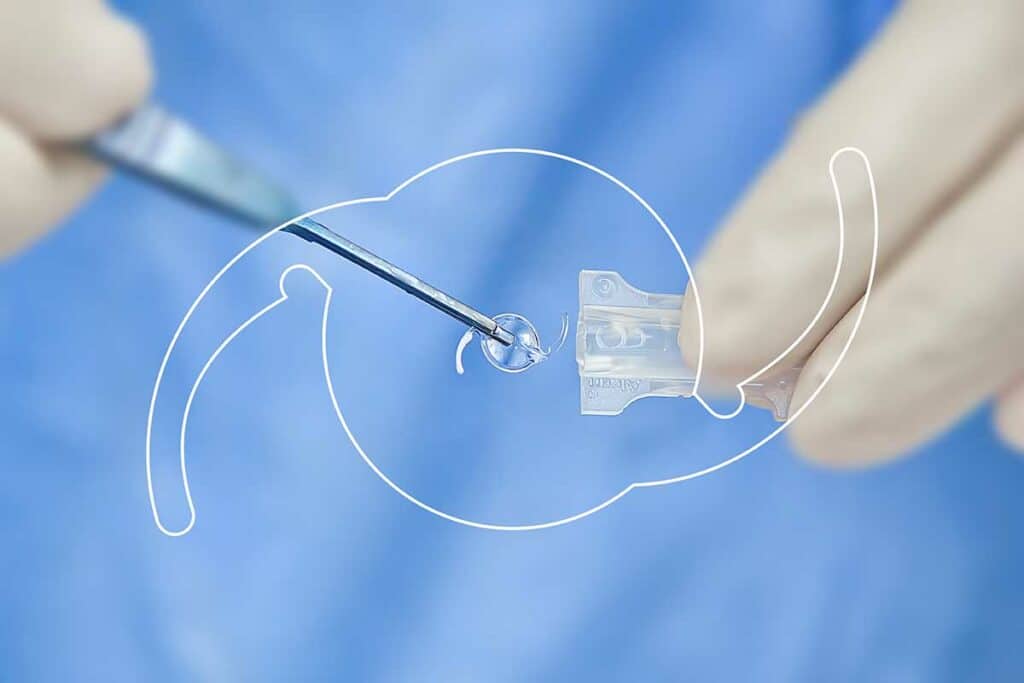
When you have cataract surgery, your eye’s natural lens, which has become cloudy, is removed and replaced with an IOL. This artificial replacement lens becomes a permanent part of your eye and will help restore clear vision.
If you are considering lens replacement surgery which is sometimes called a clear lens extraction or a refractive lens exchange, this procedure is done before you develop a cataract and is when your eye’s natural lens is replaced with an artificial lens.
The type of IOL you choose is very important as it will affect how you see for the rest of your life.
Your Once-in-a-Lifetime Opportunity
You have a once-in-a-lifetime opportunity to select the lens that will give you the best possible vision and improve your quality of life. This important decision takes time to make, and Dr. Reena Patel will explain all your options so you can make the best choice for you.
Our office will provide you with reading material and video QR codes to take home so you can better educate yourself on your options allowing you time to consider which IOL is best for you.
When considering which IOL to choose, ask yourself these crucial questions:
- Would you like to get rid of glasses completely?
- Would you like to golf without glasses or sew without glasses?
- Would you like to drive or watch television without your glasses?
- Have you had other eye surgeries?
- Do you read on a laptop or tablet?
- What hobbies do you have? How much time do you spend doing those hobbies? Do you have to wear eye protection for those hobbies?
We want to learn more about what is important to you visually so that we can help you make the right decision for yourself.
Intraocular Lens Options at Wichita Vision Institute
Standard Monofocal Lenses
Standard monofocal lenses correct your vision for either distance or near. These lenses provide excellent vision quality at one focal point.
Before cataract surgery with a monofocal lens, you will need to decide which focal length is more important to you. For instance, you may choose to correct your distance vision for activities like driving and watching TV and simply wear reading glasses when you need to read or do close work.
If you are an artist or a dentist, you might choose to improve your near vision and wear glasses for distance activities. Monofocal lenses offer reliable, clear vision and are fully covered by insurance.
Many patients are very satisfied with monofocal lenses, especially when they don’t mind wearing glasses for certain activities.
Monofocal lenses only corrected nearsightedness or farsightedness. These lenses do not fix astigmatism. If you have astigmatism, you may still need to wear glasses all the time to improve your vision.
Toric Lenses
If you have astigmatism, toric lenses can significantly improve the quality of your vision. Astigmatism occurs when your cornea is shaped more like a football than a basketball, causing blurred or distorted vision at all distances.
Toric lenses are specially designed to reduce your astigmatism while correcting your vision. By choosing a toric lens, you can achieve clearer, sharper vision with reduced dependence on glasses for your chosen focal distance at distance or near.
These lenses are particularly beneficial for patients who have moderate to high amounts of astigmatism and want the best possible vision quality after cataract surgery.
Presbyopia-Correcting Lenses
Presbyopia-correcting lenses are designed to help you see clearly at multiple distances, including far, intermediate, and near. These lenses come in different designs to meet various visual needs:
Multifocal Lenses
These lenses have multiple zones that allow you to see at different distances. The PanOptix Pro lens, for example, provides good vision for distance, intermediate (like computer work), and near tasks (like reading). Many patients find they can perform most daily activities without glasses. However, these lenses may cause halo and glare in low level light settings.
Extended Depth of Focus Lenses (EDOF)
EDOF lenses work differently from traditional multifocal lenses. Instead of having distinct zones, it extends your range of vision, providing a smooth transition from distance to intermediate vision with some near vision capability. For example, the design of the EDOF Vivity IOL often results in fewer visual side effects like halos or glare.
Light Adjustable Lens (LAL)
The LAL is the only IOL that can be customized and tailored to your vision needs after healing from cataract surgery or lens replacement surgery. After you have healed from surgery, Dr. Patel can fine-tune your vision using a special light treatment. This adjustment to your lens can help give you the exact vision you want, whether it is distance, near, or somewhere in between.
How Do I Know Which IOL is Right For Me?
Choosing the right IOL is an extremely personal decision that depends on your lifestyle, visual needs, and preferences. During your consultation, Dr. Patel will conduct a comprehensive eye examination and discuss your daily activities, hobbies, and visual goals. We will also review your eye health history and any previous surgeries which might influence your lens choice.
Some patients prioritize being glasses-free for distance activities like driving and watching TV. Others want to read and do close work without glasses. Still others want the flexibility to see clearly at all distances. There’s no right or wrong choice, only what’s right for you.
Your Next Steps
The decision about which IOL to choose does not have to be made immediately. We encourage you to take time to consider your options, discuss them with family members, and think about your long-term visual goals. Our experienced team is here to answer any questions you may have and provide additional information as needed.
Remember, this is your opportunity to not just restore your vision but also potentially improve it compared to what you have experienced for years. With the right IOL choice, many patients find they can enjoy activities they love with greater independence and confidence.
Schedule your appointment at Wichita Vision Institute today to learn more about which IOL option might be best for your unique needs and lifestyle.